
Jake Mummery bought his first Brewers Cup ticket on his birthday. That small and slightly absurd detail, yet completely deliberate, tells you something about how he approaches coffee: with genuine enthusiasm, a not-very-juicy sense of humour, and a competitive instinct he has been refining across ten years and five competition attempts. Earlier this year, he became the Irish Brewers Cup Champion, a title he chose to pursue as a way of representing the Irish side of his family, and completed his Evolved Q-Grader certification in the same fortnight. He would not recommend doing both at once.
His path through the industry has been unhurried and honest. From teaching himself on YouTube on the Isle of Wight, to several big-name cafés where he sharpened his palate, to two years managing Door Coffee Bar in Brixton. Jake has built a career around perfecting routine, curiosity, and a straightforward belief that the more you brew something, the more chances you have to make it better. He competed at the World Brewers Cup in Brussels this year, placed 38th, and is already planning his return!
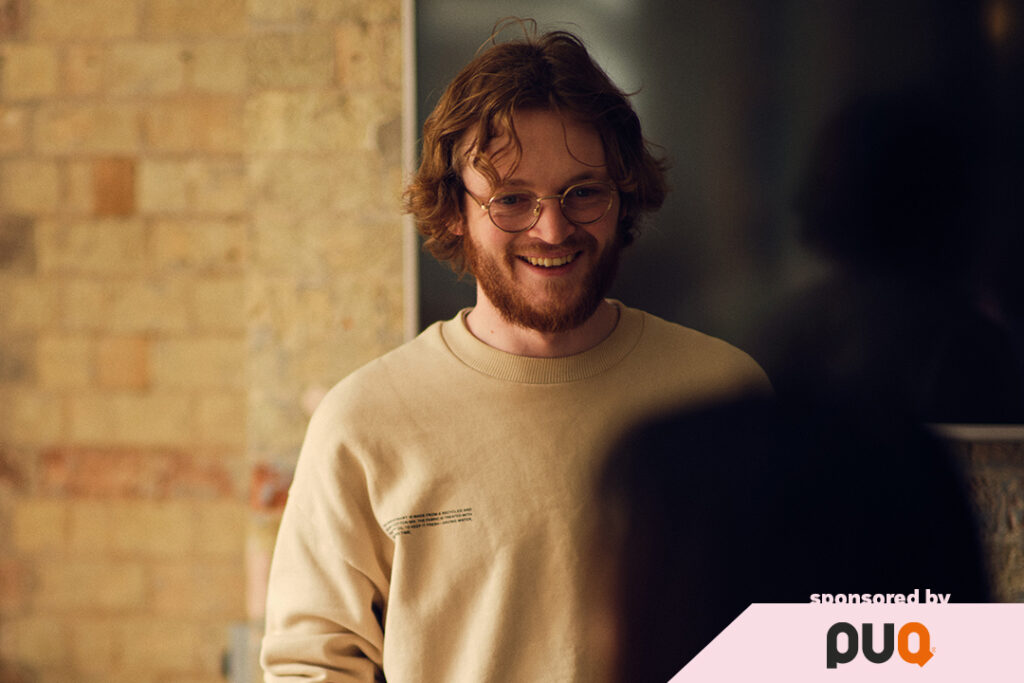
Jake, what is your first memory with coffee?
For coffee in general, it would be drinking instant coffee when I was younger with my family. For speciality coffee, it would be similar to most people’s: a natural Ethiopian that tasted like blueberries and made me realise how coffee could taste.
What inspired you to pursue a career in the coffee industry, and how did you get started? What did you do before coffee?
Before coffee, I was in university for Computer Science. I found it wildly boring and decided to work in a restaurant until I could decide what to do next. I really enjoyed making coffee there and started to pursue it further before moving to London for better opportunities within speciality.
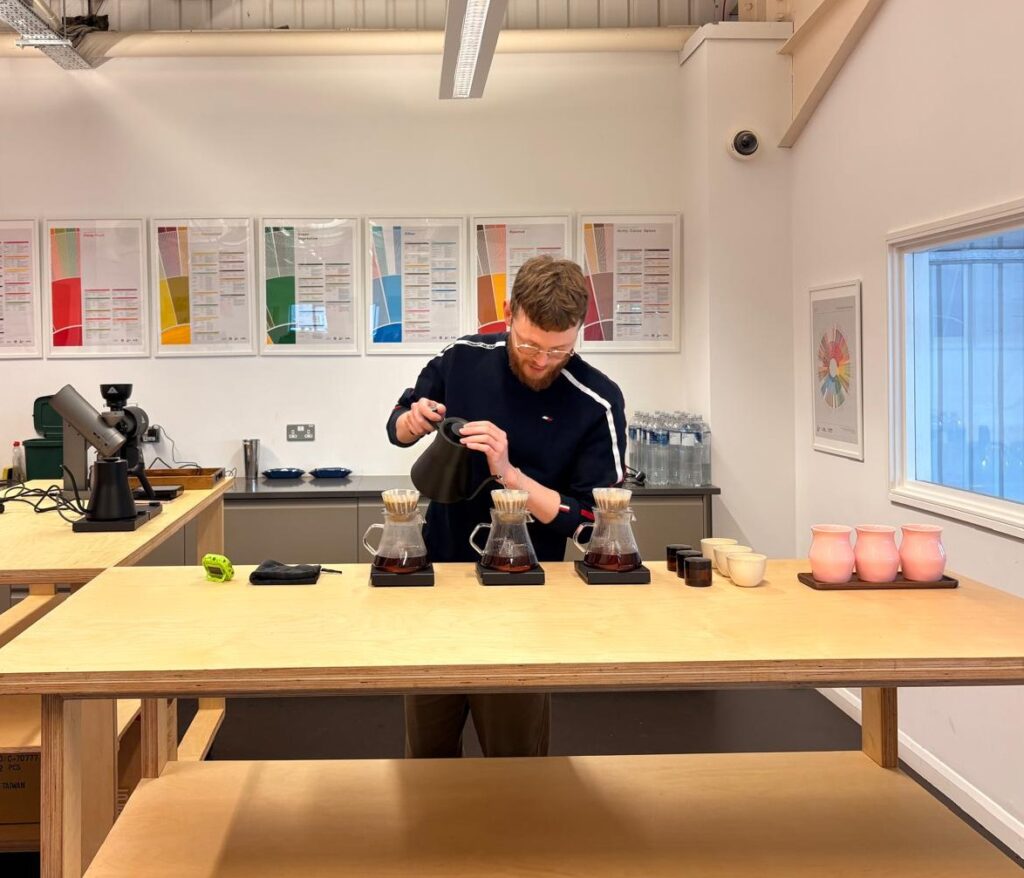
Can you walk us through your career?
My first speciality coffee job was on the Isle of Wight; it’s fairly secluded, so my progression started quite slowly, and I learned mostly on my own with YouTube. I then moved to London in 2019 and worked at Kiss the Hippo, which is where my competition journey began – the first Brewers Cup ticket I bought was on my birthday. I competed twice with Kiss the Hippo with the support of Josh Tarlo, Roosa Jalonen, and Paul Ross, making it to the finals in 2020.
In 2021, I joined Rosslyn and spent about 8 months learning to make coffee as fast as humanly possible and competing for the third time in Brewers Cup before moving to Formative. Formative was where I honed my palate and was able to focus heavily on pushing quality as much as possible. I also competed in Brewers Cup for a fourth time, but we don’t talk about that one.
In 2024, I moved to Door Coffee Bar – an Assembly and Volcano cafe in front of their Brixton offices as cafe manager. At the start of this year, I decided I would compete in Ireland’s Brewers Cup as I wanted to represent the Irish side of my family. This year my goal was to do everything I could to win, while challenging myself to also roast the coffee (with a lot of help), and for some reason complete a Q-Grader course a week before.
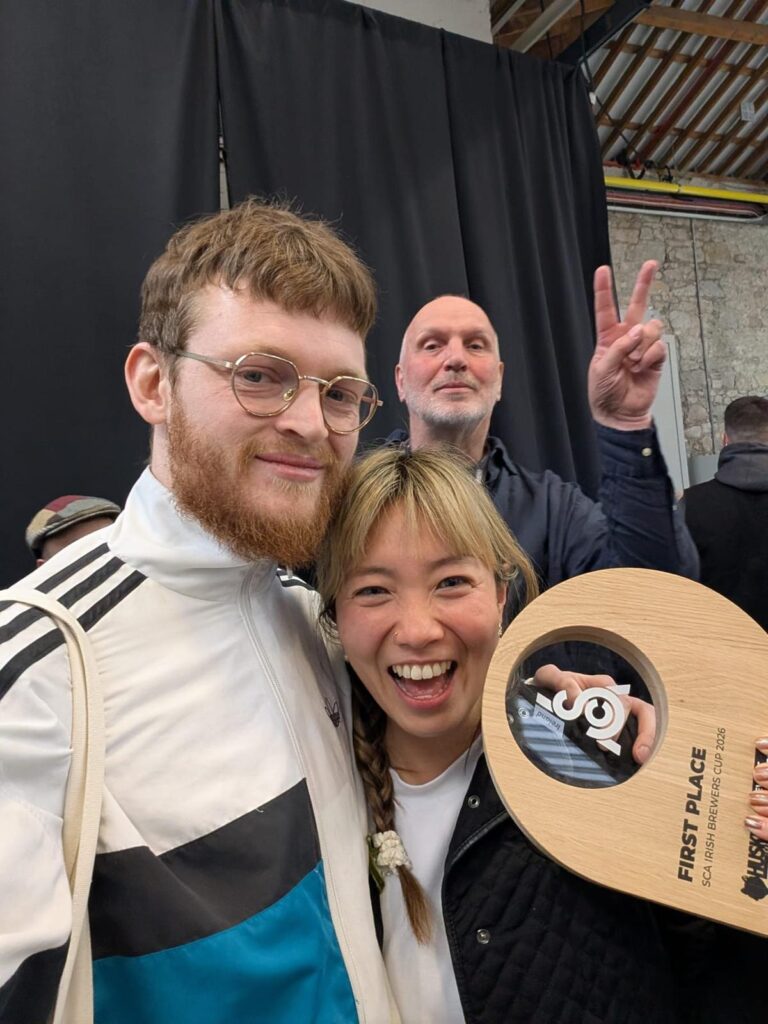
Within 2 weeks I became an Evolved Q-Grader and the Irish Brewers Cup Champion… I would not recommend doing these together. In June I travelled to Brussels to compete in the World Brewers Cup and placed 38th due to being less prepared than I had hoped, along with some unforeseen circumstances. I plan to compete again with the aim to improve this result.
Tell us a bit about the place you work at. What is your role there?
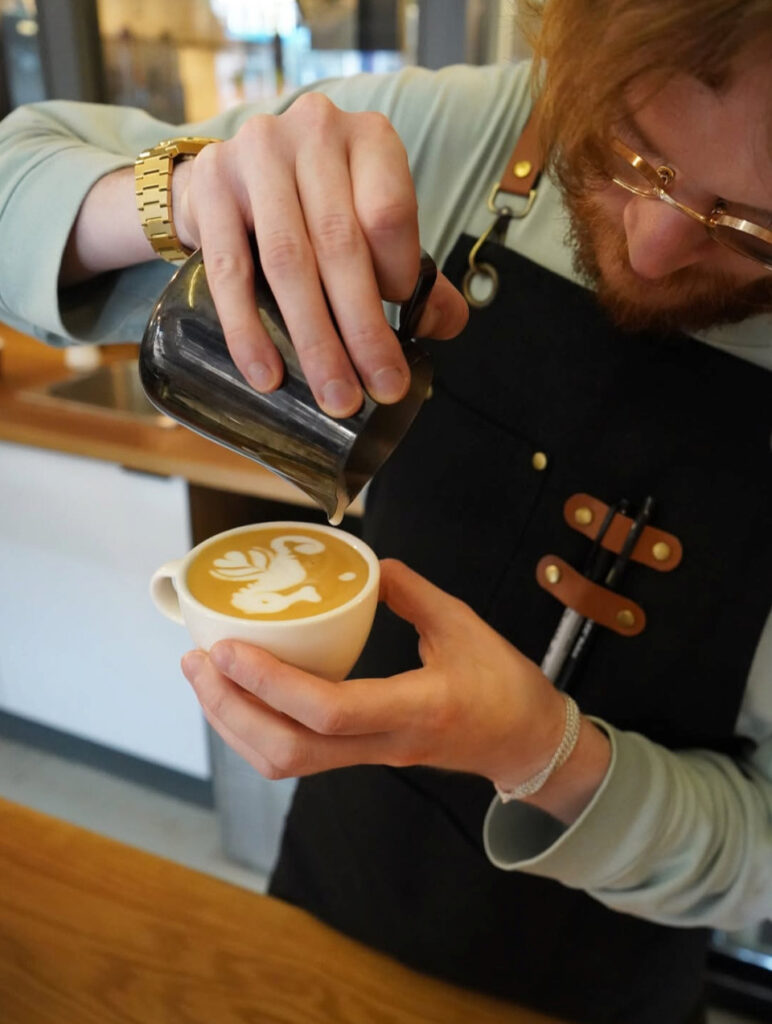
I’m just coming to the end of my time at Door. I have been a cafe manager for 2 years. It’s a small cafe in Brixton that serves Assembly and Volcano coffee in front of their office space, intending to be approachable. We do most of the work to create a coffee experience most people will enjoy, while offering the opportunity for customers to explore further into a freezer menu of rare coffees.
What kind of experience do you want your guests to have when they try your coffee?
At the risk of sounding a bit pretentious – there’s a word in Irish, ´aiteall´, that describes a brief spell of fine weather, brightness, or sunshine between two showers of rain. This has always stuck with me, and I hope that I can provide a moment of rest or happiness to someone’s day.
What is your favourite part of the day at work, and why?
Assuming close isn’t an acceptable answer, it would be just before opening during dial-in. I like the moment to myself, trying to get the best out of the coffee.
How do you stay motivated and inspired to keep improving your coffee-making skills?
Sometimes I’m not motivated to improve, and I’m quite happy to make coffee the same way for a while, but I love to experiment and try new things because you never know if they’ll work and you end up with better coffee. For the most part, I just like brewing, and the more you repeat something, the more opportunity there is to improve.
What are some common misconceptions about our industry that you’ve encountered, and how do you address them?
That coffee shops make a lot of money from huge profit margins. There are big margins on drinks, but the revenue from them is very low, so for a cafe to be successful, they need to sell hundreds, or rely on retail coffee sales with much lower margins, particularly in London and even the UK in general right now.
What are the current trends in cafes in your region? Are there any trends you promote yourself and would like to see more often in other places?
Infused or thermal shocky heavy fermented coffees to somewhat of an oversaturated extent. I’d love to see cleaner coffees taking up a bit more space on menus, in a way that balances both styles and shows off what’s great about each one.
You have some amazing achievements in championships. Can you tell us more about them?
Avoiding too much of repeating what I said earlier, I think what I consider my biggest achievements in championships would be roasting my own coffee and learning how it works to a decent degree. I also massively improved my planning and organisation skills, as well as team management and presentation skills.
How did it feel to compete on the World Stage?
It was very special, and a culmination of all of the hard work I had put in up to that point. The result was disappointing, but the moment was still special and is something I very much hope to be able to achieve again.
What was the main message you wanted to convey on stage?
Brewing good coffee isn’t just about the tools you use or finding some new way of complicating your process. Each decision can make an impact as long as you understand how it works.
What, in your opinion, is the most important thing to have in mind when you start to compete in coffee championships?
It’s not just about brewing a good coffee; there’s a lot of strategy involved. From the kind of coffee you use to how prepared you are for different conditions each day and the way you describe your coffee, it’s important to understand how each aspect of the competition is scored and where you can maximise points.

What are your passions and hobbies apart from coffee?
I like playing video games. Otherwise, food and wine take up a decent amount of my time outside coffee.
Where in your city do you find your best inspiration?
There’s no specific place, and London is a city that can provide inspiration anywhere you go. I spend a lot of time in other spaces within hospitality that lend themselves well to what I do, but also observing other cultures can bring completely new elements into coffee.
What coffee challenges are you looking forward to?
I’m looking forward to starting a role with Elsewhere Coffee very soon. It’s a new direction for me, and I’m looking forward to learning more and developing myself further.

Quick Fire Questions for Jake Mummery:
Filter coffee or espresso-based?
Filter coffee.
Milk coffee or black coffee?
Black.
The most underrated coffee drink?
Does vanilla iced latte count?
How do you make coffee at home?
Filter coffee, usually with Orea O1, my own water, and a Lagom O1 since I needed it for competition.
Favourite piece of barista equipment?
I don´t have one.
No.1 café in Europe that every coffee geek should visit?
Motors Coffee, Paris.