
Some people fall into coffee. Patrik Sláma fell into it, climbed out, looked around, and then built his entire world inside it. At 27, the Brno-based editor-in-chief of Káva spojuje and the printed magazine Okafi has worked as a barista, trainer, coffee seller, importer assistant, podcast host, and moderator, not out of indecision, but out of a genuine and restless curiosity about every corner of the industry. The thread running through all of it, as he will tell you himself, is simple: he loves sharing know-how and bringing people together.
What sets Patrik apart is the way he thinks about coffee as a community before he thinks about it as a product. His editorial work is built on a conviction that specialty coffee, which prides itself on transparency at origin, should apply that same honesty to the conversations happening within the industry itself. The tagline of Káva spojuje, “with perspective, honesty, and without compromise,” is not a marketing line. For Patrik, it is a personal standard, one he has already proven he will walk away from a job to protect.
Patrik attended a gastronomy school and then studied the Czech language and literature alongside his coffee career. That combination of craft and critical thinking really shows in his projects. He is currently writing a book on the history, physics, and chemistry of latte art, quietly championing the importance of milk quality in a world obsessed with water filtration and bean provenance. He finds his best inspiration in spaces with a view, writes fiction and paints. In an industry that often moves too fast to look up, Patrik is someone who would rather ask the right question than repeat the comfortable answer.
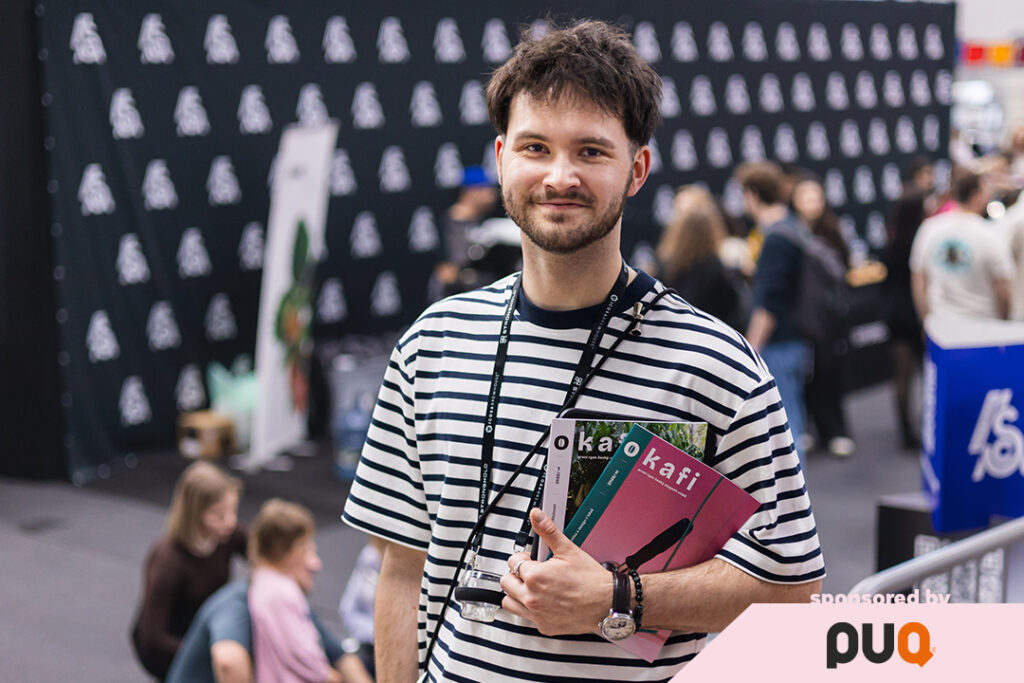
Patrik, what is your first memory with coffee?
Very old-school and traditional. A frappé made from instant coffee with milk that my parents used to make for me during summer vacation. A few years later, I upgraded to a cappuccino with cinnamon and sugar.
Can you walk us through your coffee career? What inspired you to pursue a career in the coffee industry?
It’s been a long journey filled with me trying out different roles in the world of coffee – I’m aware of that.
I graduated from a gastronomy school, where we unfortunately didn’t study coffee deeply, but somehow I got very drawn to it. In 2017, a friend of mine opened a specialty coffee shop, and she taught me most of it. I saw her passion, and she passed it on to me, I guess. At that point, I was already studying at university, and my goal definitely was not to stay in coffee. But again, somehow, I began training aspiring and home baristas through my own coffee courses. That’s when I became a coffee trainer. In addition, at that time, I was a seller of specialty beans from the Bulgarian roastery Dabov, which now has a coffee shop in Prague. That’s when I tried my hand at being a salesperson for a while.
Alongside my work, I studied Czech language and literature in college, so naturally I also began writing about coffee. Coffee journalism was something that wasn’t very common here back then, and that appealed to me. It beautifully connected my studies with my hobby.
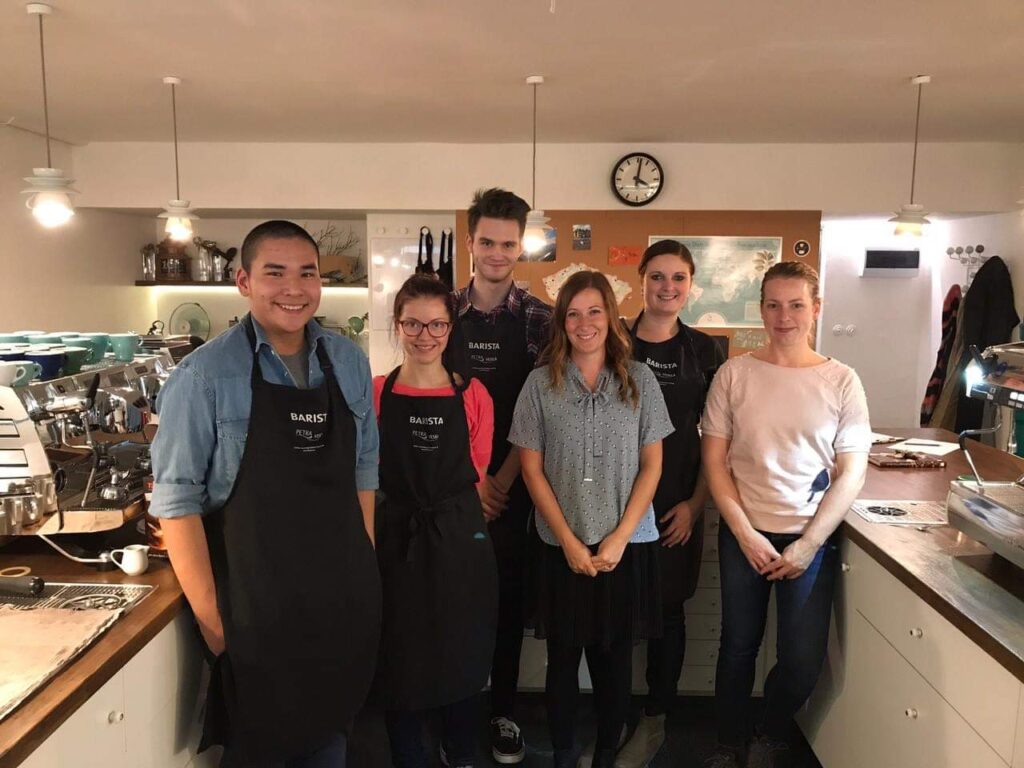
For quite a long time, I also worked for coffee import at Chicas Industry, where I learned a lot about green beans, cuppings, sample roasting and processing, and took my sensory skills to a whole new level. Unfortunately, due to time pressure, I had to quit this job, but I believe we will connect our visions somehow very soon again.
In 2023, I became editor-in-chief of a coffee magazine and online coffee blog with a great team of editors. Unfortunately, I left that workplace due to unbearable working conditions and disagreements regarding the company owners’ values and their approach to people and the coffee community. Fairness, open communication, and respecting fundamental moral principles are important to me, and we were unable to uphold these over the long term. I gradually concluded that this was not an environment in which I wanted to continue my professional career, because working there was also dividing me from the coffee industry in the end.
At that time, however, I was approached by Kateřina Bilíková and Lubomír Černý, who had previously organised the oldest Czech coffee festival – Týden kávy (Coffee Week). They asked me to launch an editorial team under their brand, Káva spojuje (Coffee Connects). I welcomed this change simply because of the name. I wanted to bring people in the coffee industry together, not divide them. And most of my former editors felt the same way, so they followed me to the Káva spojuje. So we started with an online coffee blog and podcasts.
I guess it’s the freedom, diversity, and constant evolution of this industry that drew me in. And it still inspires me. Every time you start to delve deeper into something, more and more questions come to mind that you can explore. It never ends. And once the questions are over, it means you’re not enjoying it enough to keep going.
So, short answer to your question? Passion in others is what inspires me until today.
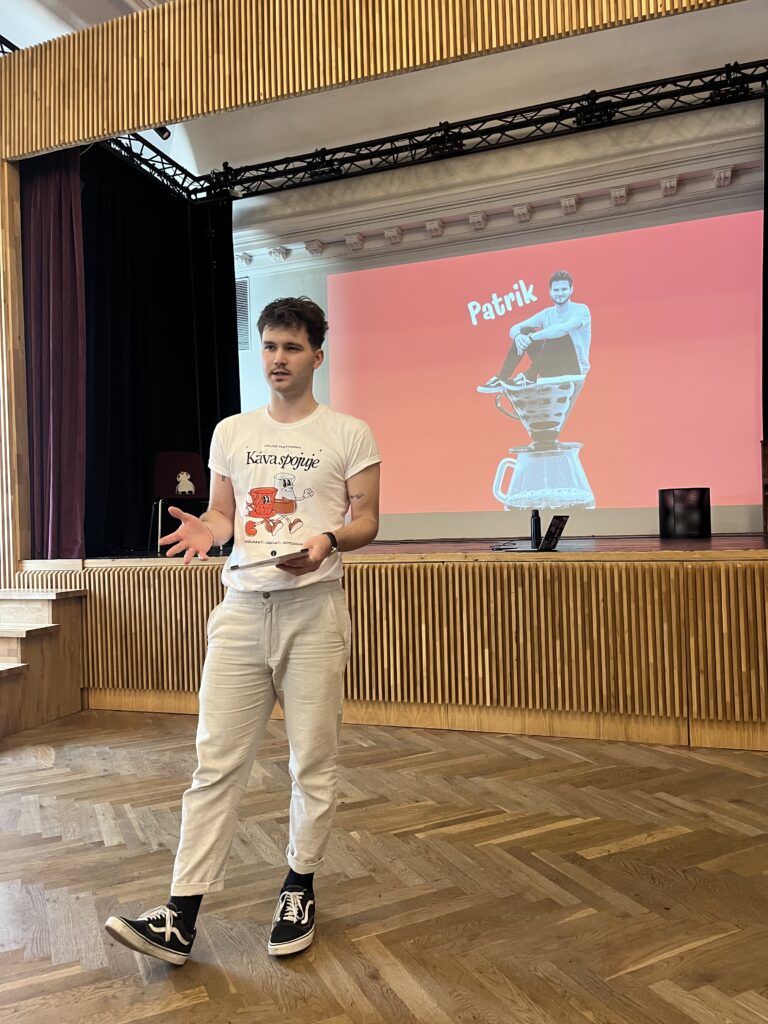
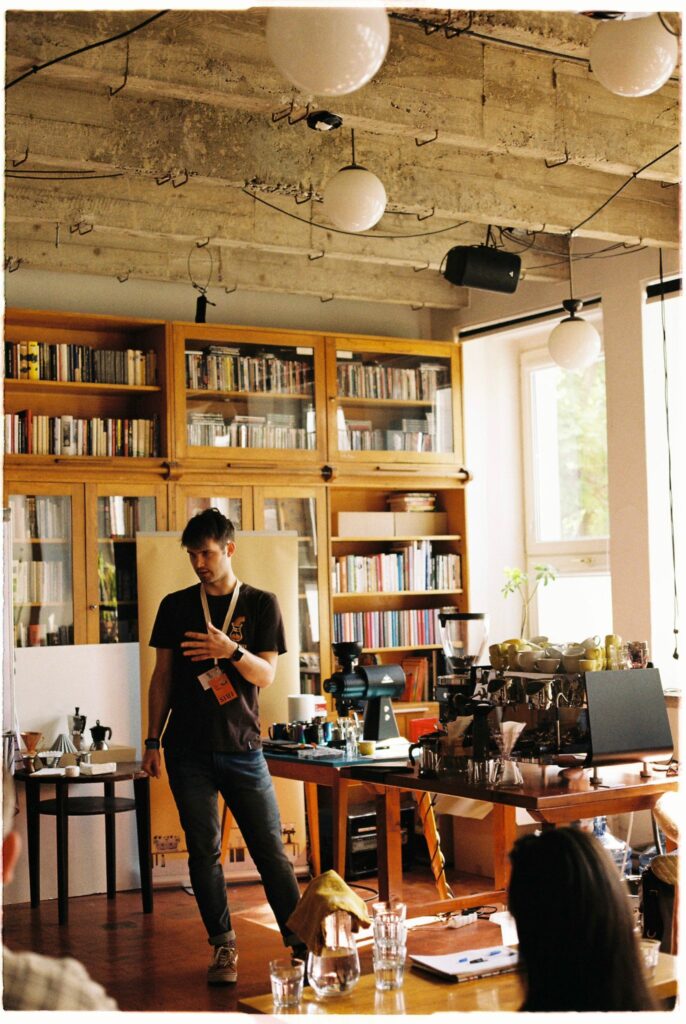
Tell us a bit about your current work and projects. What are your roles in them?
I strive to support the Czech SCA because I see just how much the team does for the Czech coffee community. That’s why we started publishing the quarterly printed magazine Okafi together with them. I have a team of people who love to write about coffee for the community, and SCA is a direct source of plenty of news from the coffee world. By purchasing the magazine or subscribing to it (a service we’ve recently launched), you can support these efforts.
We plan to conduct various experiments and research in the magazine. We don’t want it to be just a few scraps of paper filled with nonsense and advertisements. Okafi is primarily meant to have educational value. So what I do: I come up with the umbrella topics for each issue, I contribute to writing articles when necessary, I make corrections, and I coordinate the layout with the graphic designer.
We’ve also launched coffee courses this year, which we run under the Káva spojuje – simply because I missed it. We offer four types of them: from a basic barista course through latte art and brewing to sensory skills. My role in all these projects is to be a sort of initiator and educator.
You’ve moved through barista, trainer, coffee seller, importer assistant, podcast host, moderator, and now editor-in-chief – what thread runs through all of those roles that makes them feel like one story rather than many?
I enjoy teaching others and sharing my expertise. So, educating people is what connects it all together. Showing them that coffee is much more than just a drink or a way to recharge your batteries. Coffee is a community. And a community must be studied, observed, and described in order to work well.
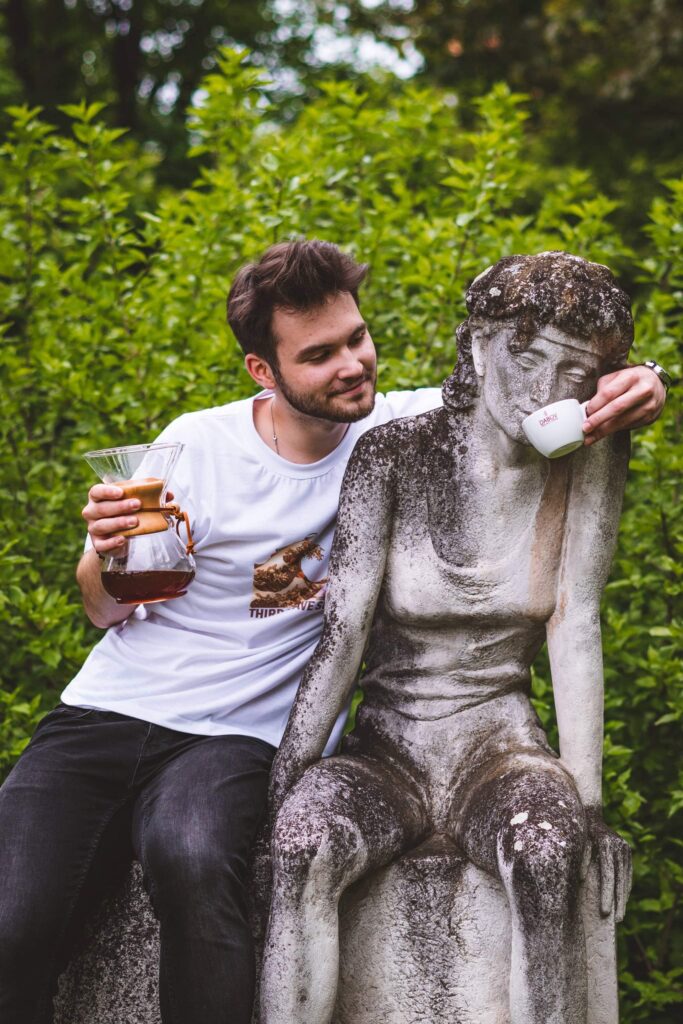
And what kind of experience do you want your guests to have when they visit you at the bar of Poppy Beans?
I want people to see that I know what I’m doing, so they can trust me to give them advice and explain things in coffee clearly, but I’m also able to adapt to their needs. I want them to feel safe with me and to experiment, try new things, and push their boundaries. And I want them to know that they can give me feedback at any time if there’s something they didn’t like or if their expectations weren’t met. I apply this principle in general when interacting with people, not just at the coffee shop.
How do you stay motivated and inspired to keep improving your coffee-making skills?
As I mentioned earlier, the coffee industry is evolving rapidly, and every new piece of information raises ten new questions. We’ll never know everything there is to know about coffee, but the pursuit of that knowledge is what keeps me in the industry. This and all the passionate people around.
The tagline of Káva Spojuje is “with perspective, honesty, and without compromise”. How hard is it to actually live up to that?
I don’t think it’s a particularly ambitious goal for us in this regard. Specifically, perspective and honesty are two qualities on which I’ve built my entire life. And I don’t always view them as necessarily positive. Because of my forward-thinking nature, I’m often constantly chasing after new things, and it’s hard to know when it’s time to switch off and relax and take a vacation. And honesty – if not conveyed sensitively – can very easily hurt someone. So one thing is whether we meet these targets, but another is how we meet them. I think that if I – or we – hadn’t succeeded, no other editorial team would have been formed.
You’ve said the magazine wants to be “a place of meeting, not a voice of one truth” – and that it’s not afraid to ask uncomfortable questions. What’s the uncomfortable question the Czech coffee scene most needs to sit with right now?
I don’t know if this is specific to the Czech coffee scene, but people in general aren’t good at accepting feedback, whether it’s positive or negative. That includes me! I’m still learning how to deal with it. I feel that the older generation isn’t used to praise, while the younger generation isn’t used to criticism.
I think we should be able to communicate more transparently with one another. Specialty coffee is built on transparency. So why not apply it to everyday life as well? And besides, oh gosh, making a mistake is the best thing that can happen to you! Did you make a mistake? Figure out what led you to it. That’s the fastest way you’ll understand the whole issue.
What are the current trends in cafes in your region? Are there any trends you promote yourself and would like to see more often in other places?
I think the coffee scene across European cities is very similar, thanks to social media and the trends spreading on it. Matcha this, matcha that. I’m not a big matcha drinker myself, but I don’t mind making it for customers. On the other hand, it seems to me that this trend is leading to a situation where I sell more matcha than coffee in a day. So am I still working in a coffee shop?
I would like people to go to coffee shops for sensory experiences, not because a café offers the same thing as every other one. In Poppy Beans we offer some special lots, a bit more expensive but a bit more interesting coffees that we can prepare on pour over or as a double shot espresso. Customers really like them, and when they like them, I’m happy that I had the opportunity to share this experience.
If there were one piece of knowledge about coffee you’d like everyone to know, what would that be?
I’m in the middle of writing a book that goes deeply into latte art – through the history of it, the physics, the chemistry… and I think that choosing the right brand and quality of milk for your café isn’t a priority today – and that’s a mistake. People care about water filtration, about proper beans, good filter paper… but the best-selling items at the café are still those that consist mostly of milk. Take an interest in milk.

What does Brno give you as a coffee city that you couldn’t find anywhere else?
I’ve mentioned several times that I think Brno is the capital of specialty coffee. There are tons of coffee shops and roasteries here relative to the city’s size and population. It’s truly inspiring to live in a place like this at this time. It’s very easy to walk down the street and pass three good coffee shops. But you get used to it very quickly and start to see it as something normal.
What are your passions and hobbies apart from coffee?
I consider myself quite culturally and artistically inclined. Writing fiction. I used to really enjoy the underground poetry scene, which is very lively in Brno. Painting. Going to the theatre. Gardening. I recently started doing Sudoku. I go for a run or a swim from time to time.
Where in Brno do you find your best inspiration?
Places with a view. I like heights and panoramic views. Not necessarily observation towers, but hilltops. And luckily, I live on a hill with a view, so it’s not that hard for me. I like to go to a pub by myself with my laptop every now and then, and just write. I love the hustle and bustle of the restaurant scene around me. I love getting wrapped up in it.
What coffee challenges are you looking forward to? Any new projects or collaborations?
So far, our editorial team has been funded by our boss’s personal funds. I would really like for it to become self-sustaining as soon as possible – not necessarily through editorial work, but simply so that our passion can pay for itself. Several possibilities come to mind, but we need to discuss them internally with the team and see what we’re willing and able to try. For now, I’ll keep them to myself.

Quick Fire Questions for Patrik Sláma:
Filter coffee or espresso-based?
Filter coffee.
Milk coffee or black coffee?
Espresso-based: milky, filter coffee: black.
The most underrated coffee drink?
Caffè latte.
The most underrated coffee brewer?
French press.
Favourite piece of barista equipment?
The automatic portafilter cleaner.
How do you make coffee at home?
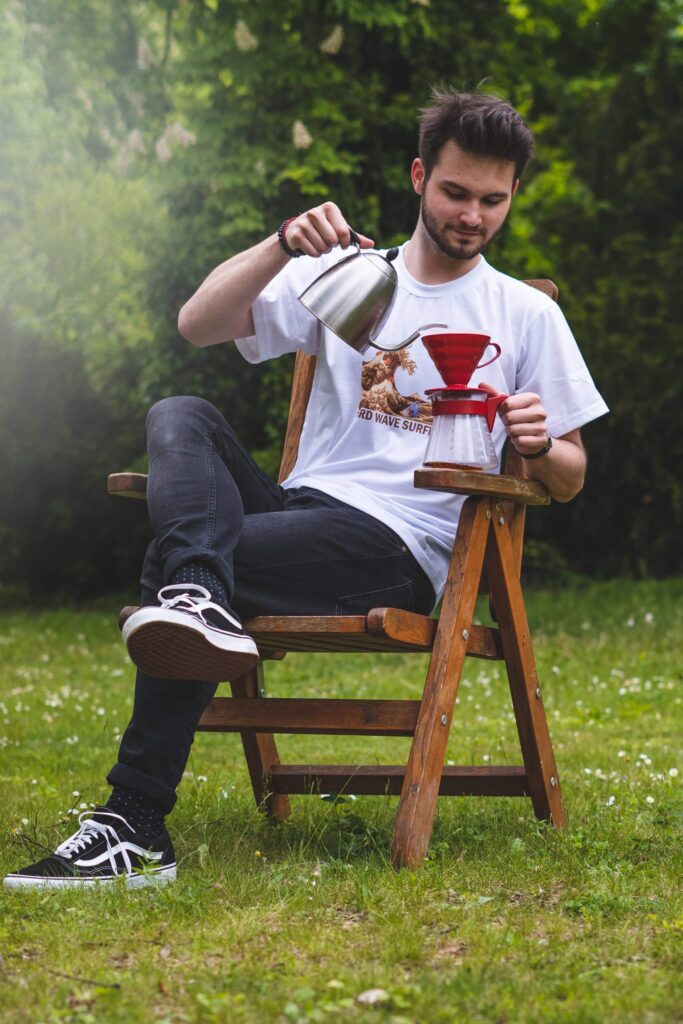
I prefer handbrew drippers. I’ve been a fan of the V60 and AeroPress for years, but now I’m trying out a flat-bottomed dripper for the first time.
No.1 café in Europe that every coffee geek should visit?
Prufrock Coffee in London.
What’s your dream place to have a coffee tour?
Again, London. There are also plenty of great specialty coffee shops there. They’re very modern. Very high quality. Very rare coffee beans. It’s just an amazing experience.