
Alyson was offered a cup of espresso at her job interview at Cøffe in Düsseldorf. She had no experience in coffee, the owner took a chance on her anyway, and that small act of welcome turned out to matter more than either of them probably expected. Three years later, she is the 2026 German Latte Art Champion, a title she earned while simultaneously completing a master’s degree and managing the kind of physical and mental preparation that most competition profiles never mention.
That honesty is one of the most fascinating things about Alyson. She has spoken publicly about how hormonal fluctuations affect the precision and patience that latte art demands, and about the extra layer of planning she and her coaches built around that reality. Long-distance running along the Düsseldorf Rhein, careful attention to diet, sleep, and recovery: the championship was the visible result of a preparation that went far beyond hours of practice pours. She could not attend the World Championship because of unforeseen circumstances, a setback she describes with the same matter-of-fact calm she brings to everything else.
From Hong Kong to Düsseldorf, Alyson has found her community in her team, coaches, and in a coffee scene she describes as genuinely welcoming. She is not particularly interested in titles for their own sake. What she values is the people around her, the exchange of skills, and the idea that competitions should push everyone forward, not just the person holding the trophy. She would also love to see more FLINTA and non-binary people on the German Coffee Championships stage. On that, she is not waiting for someone else to say it first.
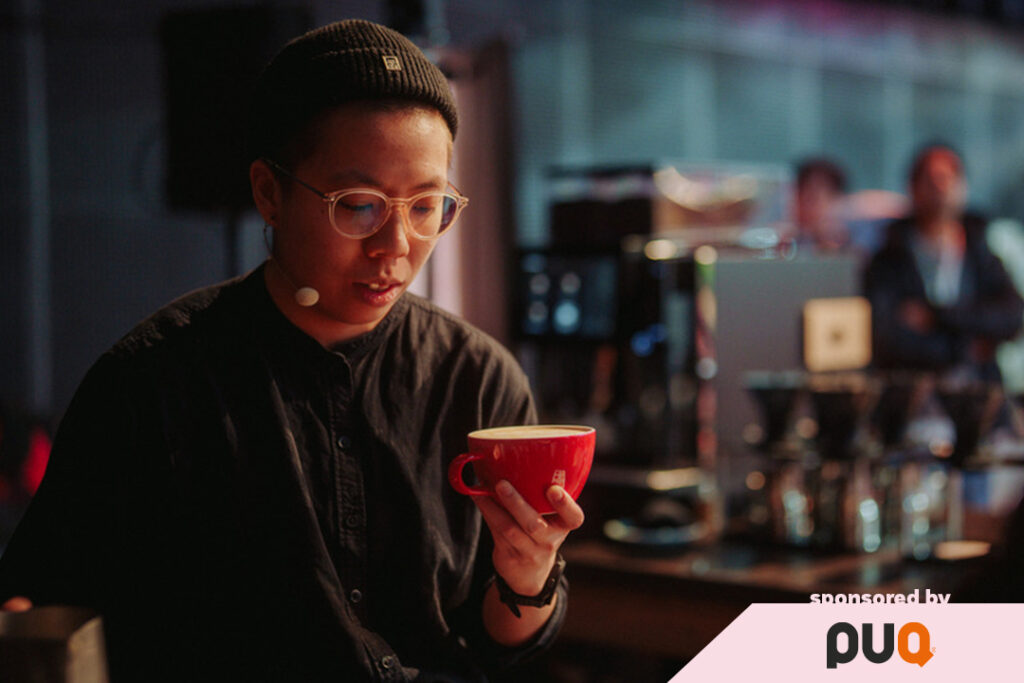
Alyson, what is your first memory with coffee?
I remember having a job interview at Cøffe with Tufi. I didn’t have any experience working in the coffee industry before, so I was a bit nervous. Then he greeted and welcomed me with a cup of espresso. This was definitely not the first cup of espresso in my life, but it was the most memorable one — and the first cup that comes to mind. He was kind enough to take on an inexperienced person, and the rest is history.
What inspired you to work in the coffee industry, and how did you get started?
You may find it cliché, but at that time I worked as a student assistant at uni during the day and as a bartender at night. At some point I just told myself: you should try working as a barista too. Your early twenties are the prime age for it, hahahaha.
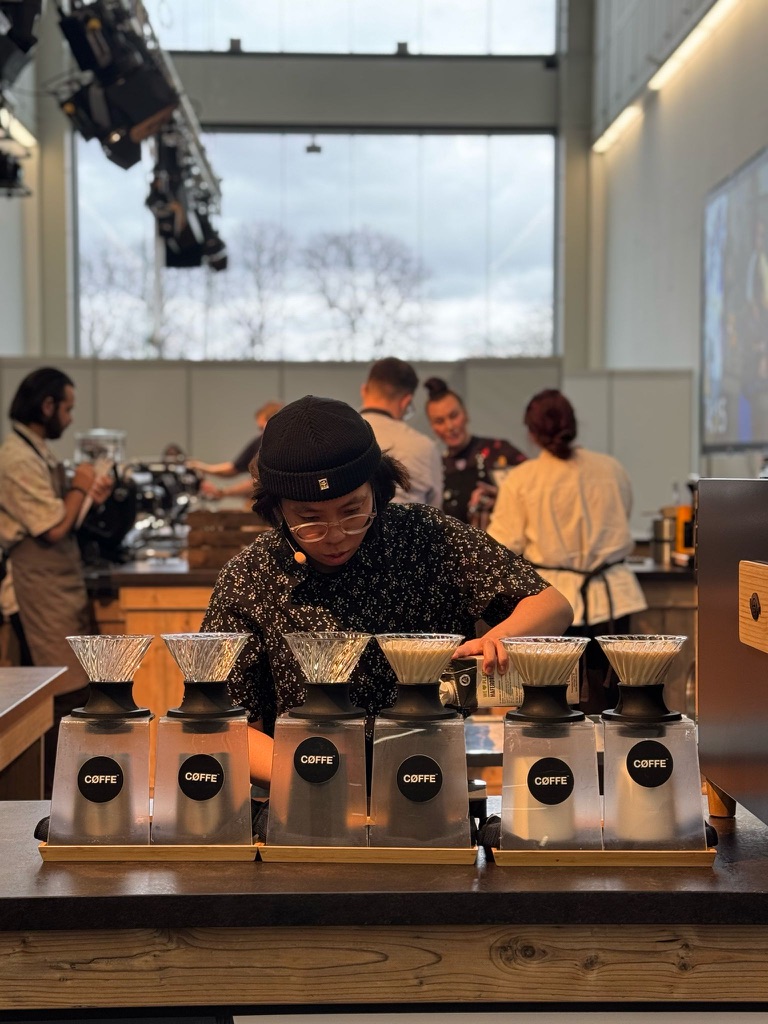
Tell us a bit about the place you work at. What is your role there?
Cøffe is a specialty coffee shop whose staff come from various cultural backgrounds, yet everyone shares the same value: a kind heart. Working here, I’ve had so much support from my boss, Lukas, especially when it comes to competitions. And apart from competitions, I’m just a regular barista like my colleagues.
What kind of experience do you want your guests to have when they visit you at the cafe?
Let’s say you visit me in Düsseldorf and we have a conversation. First, I want you to feel welcome – not only by the city but also by our coffee community, full of friendly, talented baristas. Then I want the visit to feel less like being served and more like catching up with a friend. The coffee matters, but it’s not the star; it’s what we hold while we talk. And when you leave, I hope you take a real connection with you, not just a good cup.
What is your favourite part of the day in your cafe, and why?
Morning shifts on weekdays, quiet mornings with regular customers, a bit of chit-chat. Together with the location of the coffee shop, it made for an easy, chill morning.
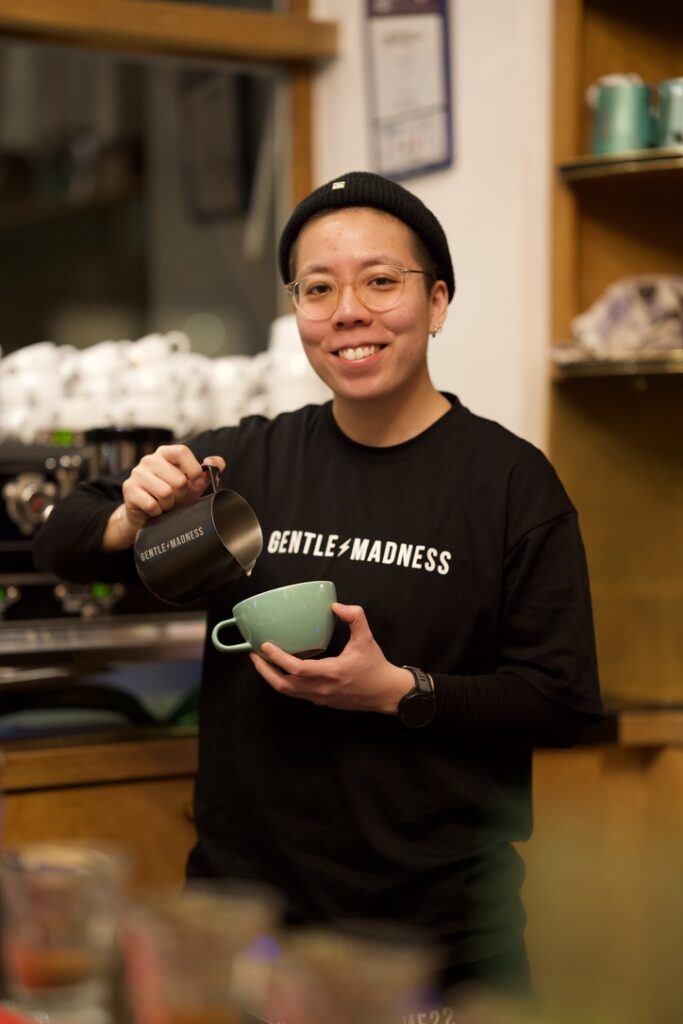
How do you stay motivated and inspired to keep improving your coffee-making skills?
I think it’s mostly because I’m surrounded by coffee nerds, especially one of my coaches, Khai, and many other people in the Düsseldorf Cupping Club.
What are some common misconceptions about our industry that you’ve encountered, and how do you address them?
I think people underestimate the skills you need for latte art. When I first started, I had that misconception as well. I was too eager – every time I had the chance, I wanted to challenge myself with a harder pattern. But I’m very glad this idea didn’t last long, because someone corrected me, saying that serving a neat cup matters more. Then I met Duncan Lim, my coach, who nudged me toward being more detail-driven.
What are the current trends in cafes in your region? Are there any trends you promote yourself and would like to see more often in other places?
My colleagues introduced us to the Ube latte – it’s really good. What I’d like is a closer circle of people exchanging their coffee skills. For example, where I’m from, Hong Kong, there are always so many meet-ups to pour a few cups together. And in Düsseldorf, we have the Düsseldorf Cupping Club (DCC). They have a regular weekly meet-up to cup different kinds of coffee and exchange coffee knowledge – there are brewers, latte artists, roasters, Q graders, and judges. So it’s a really welcoming atmosphere for sharing the passion.
You have some amazing achievements in championships. Can you tell us more about them?
Such an achievement comes not only in the moment of the competition, but in the preparation. You can always go back to YouTube and watch how I performed and competed, so let me share something that isn’t easily visible or even presentable by most competitors. Preparation doesn’t only mean the hours upon hours my team and I put into the cups, but many other factors too.
As I’ve mentioned on my Instagram, as a female competitor, I deal with hormonal changes, which is critical when a competition demands high accuracy and precision. Hormonal fluctuation gives me shivers and less of the patience I need for attention to detail. On top of hours of practice on cups and routines, it means I have to spend extra time regulating my hormones, adapting to higher pressure, and learning how to control my body and mind.
I shared online that I took up long-distance running for that, but there were many more approaches my team and I organised to get me in the best condition for the competition, such as diet, sleep, and a recovery plan. Besides all this, I’m also doing my master’s degree at the same time, so juggling everything was very challenging. This achievement is mainly due to my coaches’ planning, since they factor in all of this and let me just follow their plans. So everything up until the German Latte Art Championship worked quite well – and of course there’s always room for improvement – but the title itself works really well as a tribute to everyone’s hard work.
Unfortunately, I wasn’t able to go, because my passport was lost by a third party – something outside my control – and there was no way to find an alternative in time, nor anything I could have done earlier.
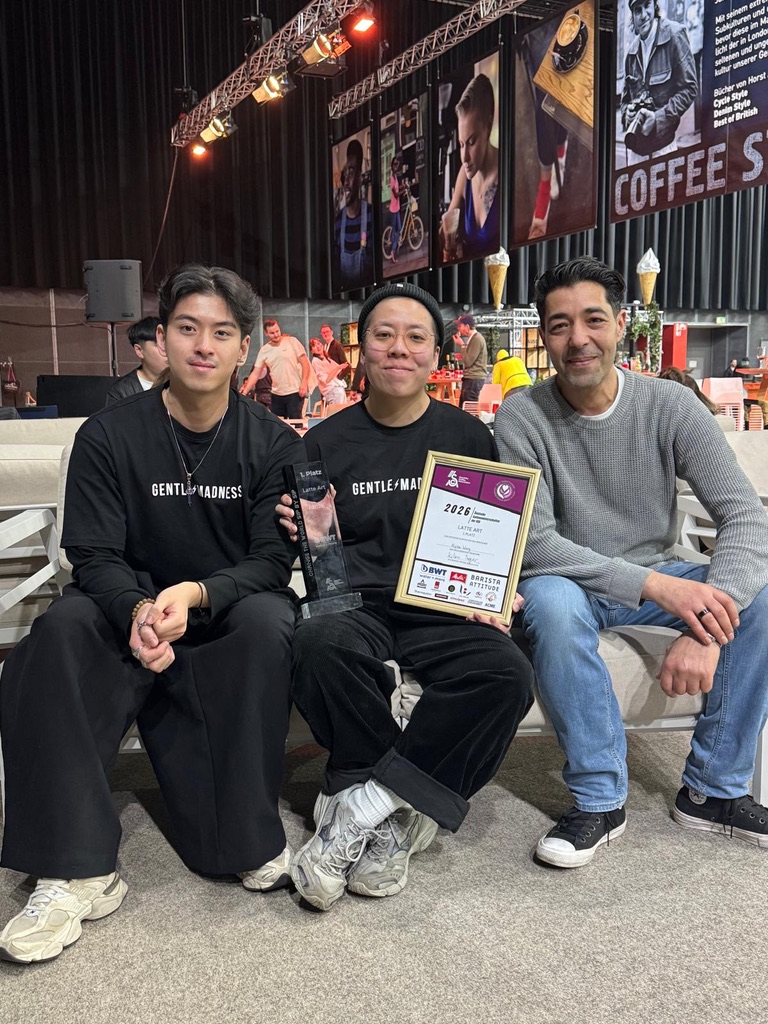
What is so compelling in Latte Art for you, and why did you decide to compete in this discipline?
I’ve liked latte art since the moment I learned any coffee skill – it’s just very challenging, and it requires so many skills from you at once. And I just love that kind of challenge!
What are the next championships you’d like to compete in?
I’m not a planner, so I don’t know yet. I’d like to put my priority for the coming year on my other focus first, then I’ll think about it. But I’d love to see more FLINTA and non-binary people in the German Latte Art Championship.
What, in your opinion, is the most important thing to have in mind when you start to compete in coffee championships?
Values and beliefs – it is indeed a competition; everyone wants to give their best, but it shouldn’t only be a competition against others. For example, I really admire our new roasting champ, Ellie, our first non-binary champion, not only because of their skills in roasting, but also their dedication to representing the under-represented community.
If there were one piece of knowledge about coffee you’d like everyone to
know, what would that be?
There is a classic Chinese line about rice, “Every single grain of rice means hard work”, 粒粒皆辛苦, and I think it applies to coffee as well, “Every bean in your cup costs someone sweat”. Value your farmers, value your workers.
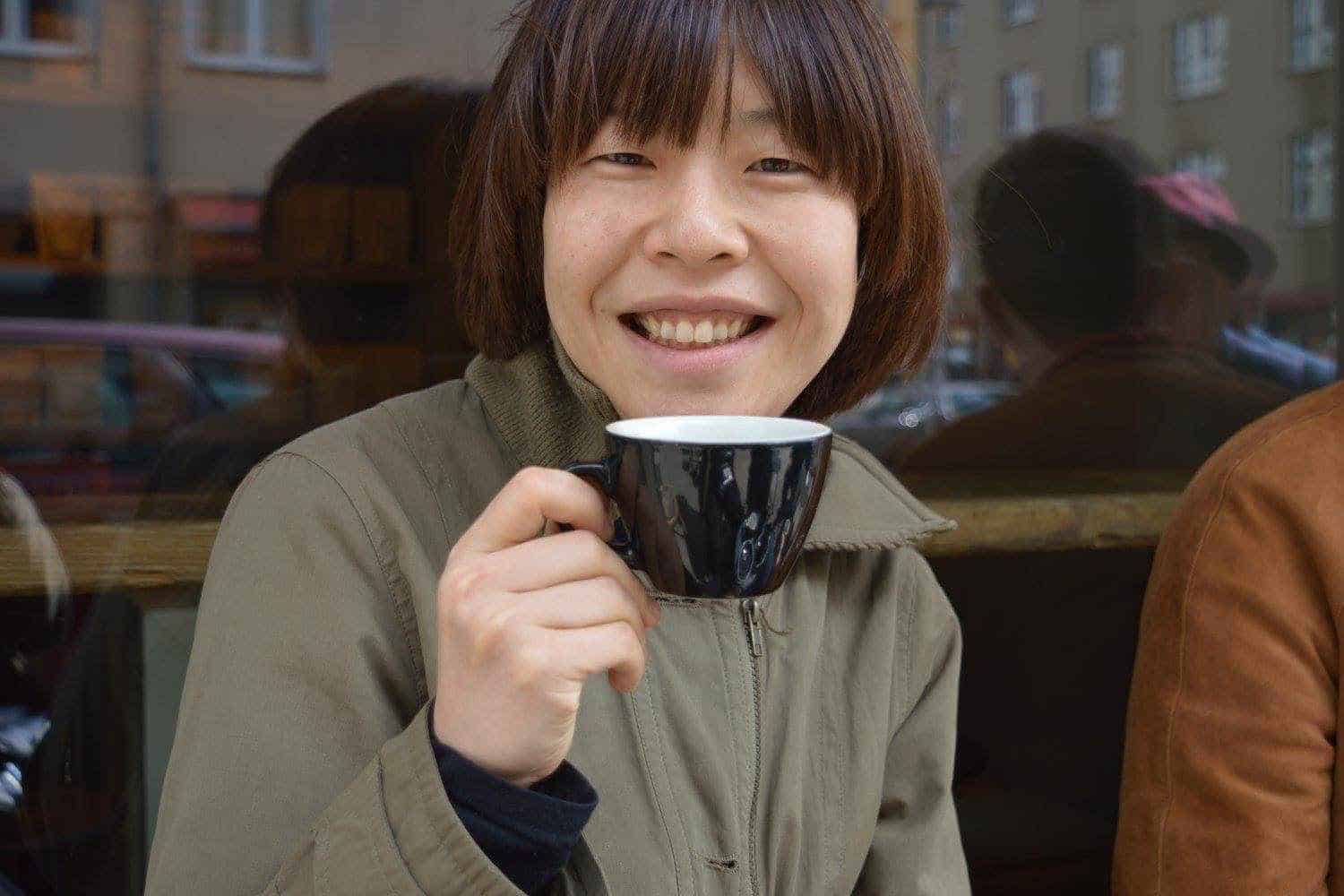
What are your passions and hobbies apart from coffee?
I’m currently working toward a master’s degree. Apart from coffee and studying, I’ve picked up running as a hobby – sorry, no running club; I really enjoy running alone or privately with a few friends.
Where in your city do you find your best inspiration?
Along the Düsseldorf Rhein, where I usually run and think about my life.
What coffee challenges are you looking forward to? Any new projects or collaborations?
There are many things I’d like to learn, since I’ve met so many inspiring people over these years – brewing, teaching, roasting, judging. I don’t have a concrete plan yet, but these are the directions.

Quick Fire Questions for Alyson:
Filter coffee or espresso-based?
Filter coffee.
Milk coffee or black coffee?
Black.
The most underrated coffee drink?
Espresso orange… I just lowkey like it!
How do you make coffee at home?
I don´t, lol!
Favourite piece of barista equipment?
Milk pitchers (of course).
What’s your favourite city to have a specialty coffee tour outside of “your city”, why?
Cologne – you can find all kinds of coffee shops there, and they’re super friendly, partly because the city is so inclusive.